

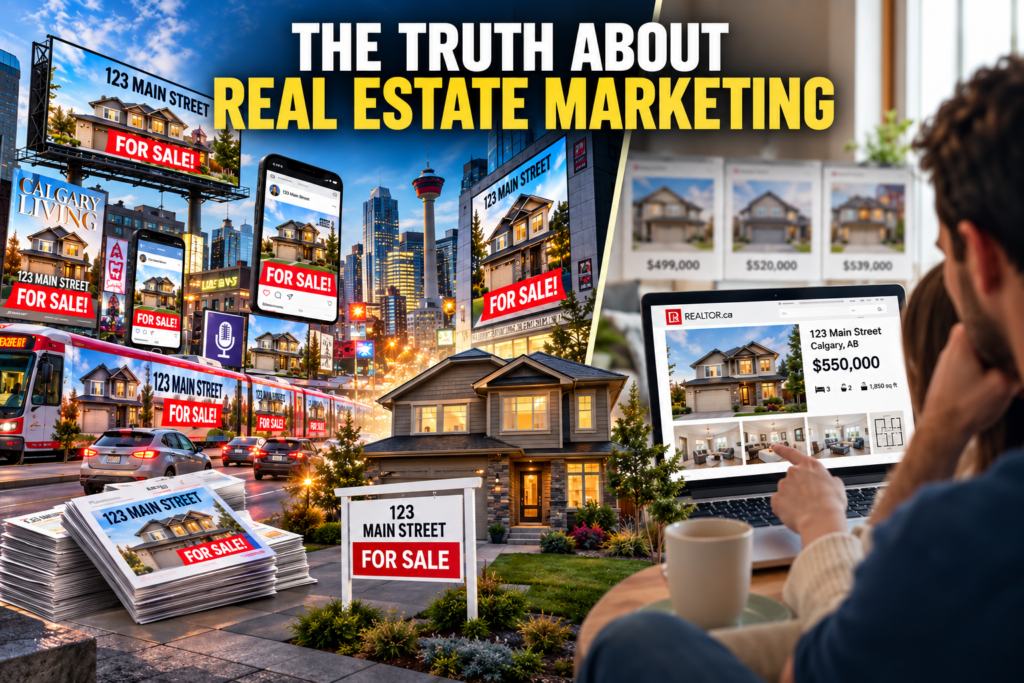
Let’s conduct a ridiculous experiment.
I have a property worth $500,000, and I have an unlimited advertising budget.
And when I say unlimited, I mean it.
I’m going to spend $10 MILLION advertising a $500,000 property.
Of course, somebody has to pay for this insanity, so instead of listing the property at its actual market value of $500,000, we’re going to ask $550,000.
The property is 123 Main Street.
I hire the best advertising agency in the world and tell them to make sure that virtually every person in Calgary knows about 123 Main Street.
And they do.
You can’t open Facebook, Instagram or TikTok without seeing it.
You Google “weather in Calgary”? There’s 123 Main Street.
There are gorgeous full-page ads in magazines.
It’s on five radio stations.
It’s plastered across C-Trains.
There are billboards all over Calgary.
We send a beautiful, glossy, full-colour brochure to every household in the city.
For weeks, you practically can’t leave your house without being reminded that 123 MAIN STREET IS FOR SALE!
We have achieved marketing saturation that no REALTOR® in history could possibly duplicate.
So what happens?
The property doesn’t sell.
Why?
Because almost all that advertising was completely worthless.
The overwhelming majority of Calgarians aren’t looking for a $500,000 property in that particular area. They might see the advertising. They might even remember the address.
But they’re not buying it.
They were never buying it.
So what about the tiny percentage of people who actually are looking for a property like this?
Here’s the important part:
THEY ALREADY KNEW ABOUT IT.
These are serious, active buyers. They’re watching REALTOR.ca. They have searches set up with their agents. They get notified when new listings hit the market.
And that brings us to the part of real estate marketing that actually matters.
THE MLS PRESENTATION
If I had to identify the two most important factors in successfully marketing a property, they would be:
1. Price it accurately.
2. Present it powerfully on the MLS.
Why?
Because that’s where the serious buyers are already looking.
You don’t have to hope that someone scrolling Instagram happens to be looking for a house.
You don’t have to hope that someone driving past a billboard is planning to buy in your neighbourhood.
You don’t have to hope that somebody listening to the radio happens to need a four-bedroom house with a double garage in your price range.
On the MLS, they’ve already identified themselves as buyers.
They’re searching your neighbourhood.
They’re searching your price range.
They’re comparing your property directly against every competing property on the market.
This is where your marketing needs to be exceptional.
That means outstanding professional photography that makes someone stop scrolling.
It means presenting the photos in the right order so they tell a story instead of looking like a random collection of rooms.
It means compelling listing copy that doesn’t just recite the number of bedrooms and bathrooms, but explains why someone would want to live there.
It means identifying the features that actually separate the property from its competition and making sure buyers don’t miss them.
It means floor plans, measurements, video and supporting information that help buyers understand the property before they ever walk through the front door.
Most importantly, the entire presentation needs to answer one question:
“Why should I consider THIS property instead of the other ten I just looked at?”
Because that is exactly what buyers are doing.
They aren’t evaluating your property in a vacuum.
They’re clicking through your listing, then the next one, then the next one.
They’re comparing kitchens.
Backyards.
Renovations.
Locations.
Floor plans.
Garages.
Condition.
And, of course…
PRICE.
You have only seconds to make them stop and think:
“Wait. This one looks interesting.”
That’s real estate marketing.
Not trying to reach the greatest possible number of people.
Reaching the right people and giving them a compelling reason to want to see the property.
And then — critically — offering it at a price that makes sense compared to everything else they can buy.
Because if those two things are right — the presentation and the price — you’ve done the two most important things you can possibly do to market a property.
Back to 123 Main Street.
Many of those serious buyers have already toured it.
They’ve also toured its competition.
They’ve compared the size, condition, location, features and — most importantly — price.
And they’ve reached exactly the same conclusion:
At $550,000, it isn’t worth it.
So they bought something else.
Or they’re still looking.
Or they’re waiting for the seller of 123 Main Street to finally accept what the market has already told them.
Here’s the lesson:
You cannot advertise your way out of an overpriced listing.
You can have better photography.
Better video.
Better social media.
Better brochures.
More Facebook ads.
More Google ads.
More signs.
More exposure.
Hell, you can wrap every C-Train in Calgary with a picture of the kitchen.
It still doesn’t change what the property is worth.
Marketing absolutely matters.
But effective real estate marketing isn’t about shouting the loudest or spending the most money.
It’s about putting a powerful, compelling presentation in front of the people who are actually in the market to buy — and pricing the property so that it competes.
Those are the two big ones:
PRESENTATION + PRICE.
Get the presentation wrong and buyers may scroll right past you.
Get the price wrong and they may love the property — and buy the one down the street instead.
And no amount of advertising changes that.
The best marketing in the world cannot fix the wrong price.
If you want to sell a property, create an exceptional presentation for the people who are actually looking for it, and price it accurately to the market.
That’s infinitely more important than spending $10 million trying to convince the market that it’s wrong.